Showing posts with label multiple controllers. Show all posts

Tuesday, August 4, 2015

Centralized vs. Distributed SDN Control Path Paradigm

In a previous post I covered some misconceptions about SDN management and my view of the importance of the hybrid(proactive/reactive) model for scalability, and how we used this approach in the design of Dragonflow.

Today, i will discuss the two existing paradigms to SDN control path, and how it affects our road map in the Dragonflow project.

The first approach is the Centralized Controller.  Here, a controller (or a cluster of them) manages all the forwarding elements in the system, and retains a global view of the entire network. 

Most SDN controllers today run this way (ODL, ONOS, as well as Kilo version of Dragonflow).

The second approach is the Distributed Control Path.  Here, a local controller runs on each compute node and manages the forwarding element directly (and locally).  Thus, the control plane becomes distributed across the network.  

However, the virtual network topology needs to be synchronized across all the local controllers, and this is accomplished by using a distributed database.

Like everything else in life, there are advantages and disadvantages to each approach.  So, let's compare: 


Centralized Control Path


Pros


  • The controller has a global view of the network, and it can easily ensure that the network is in a consistent, optimal configuration
  • Simpler, agentless solution - Nothing needs to be installed on the compute nodes 
  • Any and all southbound APIs can be supported directly from the centralized controller (easier to integrate with legacy equipment)

Cons

  • Added latency in newly established flows, becomes a bottleneck in large scale deployments
  • Dependency on the controller cluster availability and scale
  • All advanced services are handled centrally, instead of locally, perpetuating a bottleneck as the scale grows
  • Large scale is usually controlled via BGP-based Confederations and multiple SDNC clusters which add more latency and complexity

Distributed Control Path


Pros

  • You can manage policies and introduce advanced services locally on each compute node, since you already have a local footprint
  • Significantly better scalability, now that you have the control plane completely distributed
  • Significantly better latency during reactive handling of PACKET_IN
  • Highly-available by design and no single-point-of-failure
  • Easier to integrate Smart NIC capabilities on local host level

Cons

  • Synchronization of the virtual network topology can be a challenge, as the amount of compute nodes increases
  • No global view
  • Extra compute is done on the local host
  • If you have heterogeneous forwarding elements (e.g. legacy switches), you need to have a centralized controller that connects them to the distributed control plane (which can complicate the management) 


What we chose and why


We decided earlier-on to go with a hybrid reactive/proactive model (against the widely-accepted proactive-only approach), as we saw that its advantages were overwhelming.  

The winning point of the reactive mode, as we see it, is that it improves the performance of the datapath, taking the performance toll instead on the control path of newly-established flows.  The main reason for that being a dramatic reduction of the number of flows that are installed into the forwarding element.

When combined with a pipeline that is deployed proactively, we could maximize the benefits of the reactive approach, while minimizing its cost.

However, like all solutions, at a certain scale it will break.


In very large deployments (e.g. a full datacenter), a central controller cluster becomes overwhelmed with the increase in volume of new connections.

A centralized controller made sense, while we were only handling new L3 connection path establishment (Dragonflow in Kilo).

However, when we came to add reactive L2 and other advanced services (like DHCP, LB, etc.), we realized that scaling the centralized controller cluster was becoming a huge challenge. 

A different approach must now be taken, and we believe this approach is to place a local controller on each compute node.  

Now that the control path bottleneck was mitigated, the problem moves to the logical data distribution between all the local controllers.

To mitigate that, we believe we can reuse the reactive approach, by letting the local controllers synchronize only the data they actually need (in lazy mode) use key/value distributed db engines that provide low latency. 

Sure, this will probably take some performance toll on the establishment of new flows, but we believe it will dramatically reduce the amount of data synchronization required, and therefore will take us to the next scalability level.


What we are doing in Dragonflow
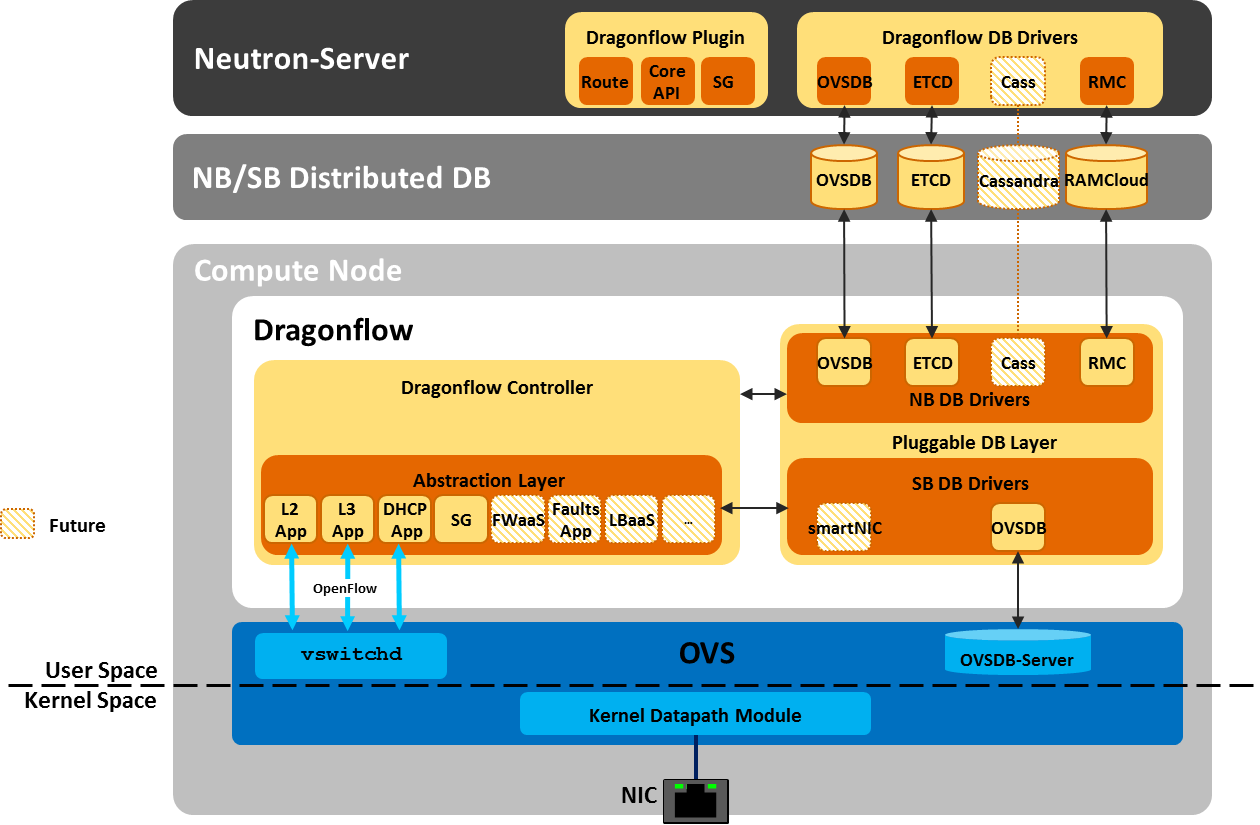


We are currently working on introducing reactive L2 and L3 model into the local Draongflow controller.  

We are creating a pluggable distributed database mechanism to serve the logical data across the datacenter, which will enable the user to chose the best database to meet their specific needs and scale.

As always, we would love to have more people join the Dragonflow community and contribute to its success.

For additional information about the pluggable database layer, you can check out Gal Sagie's new blog post.

Thursday, January 22, 2015

Neutron DVR The SDN Way

In my previous posts I covered the existing Openstack virtual L3 implementations, from the base centralized implementation to the state of the art solution, DVR, that distributes the load among the computes nodes.

I also summarized the limitations of DVR and hopefully convinced you of the motivation for yet another L3 implementation in Neutron.

Just to quickly recap, the approach for DVR’s design was to take the existing centralized router implementation based on Linux network namespaces and clone it on all compute nodes. This is an evolutionary approach and a reasonable step to take in distributing L3 from which we've learned a lot. However, this solution is far form optimal.

In this post I’m going to present a PoC implementation of an embedded L3 controller in Neutron that solves the same problem (the network node bottleneck) the SDN way, and overcomes some of the DVR limitations.

I chose to start with just the East-West traffic, and leave the North-South for the next step.


I will share some of my ideas for North-South implementation in upcoming posts, as well as links to the Stackforge project.


If you're interested in joining the effort or take the code for a test drive, feel free to email me or leave a comment below.


SDN Controllers are generally perceived as huge pieces of complex code with hundreds of thousands of lines of code that try to handle everything.  It's natural that people would not deem such software to be capable of running "in line".  However, this is not necessarily so.  As I will demonstrate, the basic SDN Controller code can be separated and deployed in a lean and lightweight manner.

It occurred to me that by combining the well-defined abstraction layers already in Neutron (namely the split into br-tun, br-int and br-ext) and a lightweight SDN controller that can be embedded directly into Neutron, it will be possible to solve the network node bottleneck and the L3 high-availability problems in the virtual overlay network in a simple way.

Solution overview 

The proposed method is based on the separation of the routing control plane from the data plane. This is accomplished by implementing the routing logic in distributed forwarding rules on the virtual switches. In OpenFlow these rules are called flows. To put this simply, the virtual router is implemented in using OpenFlow flows. 
The functionality of the virtual routes that we should address in our solution is:


  • L3 routing
  • ARP response for the router ports
  • OAM, like ICMP (ping) and others


L3 Controller embedded in Neutron POC


We decided to create our controller PoC with Openstack design tenets in mind. Specifically the following:

  1. Scalability     - Support thousands of compute nodes
  2. Elasticity       - Keep controllers stateless to allow for dynamic growth 
  3. Performance  - Improve upon DVR
  4. Reliability      - Highly available
  5. Non intrusive - Rely on the existing abstraction and plug-able module

What we intend to prove is:
  • We indeed simplify the DVR flows
  • We reduce resource overhead (e.g. bridges, ports, namespaces)
  • We remove existing bottlenecks (compared to L3Agent and DVR)
  • We improve performance
We've started benchmarking the different models and I'll post results as soon as we have them ready.


Reactive vs. Proactive Mode

SDN defines two modes for managing a switch: reactive and proactive.
In our work, We decided to combine these two modes so that we could benefit from the advantages of both modes (although if you believe the FUD about the reactive mode performance, it is quite possible to enhance it to be purely proactive). To learn more about this mixed mode see my previous blog


The Proactive part

In the solution we install a flow pipeline in the OVS br-int in order to offload the handling of L2 and intra-subnet L3 traffic by forwarding these to the NORMAL path (utilizing the hybrid OpenFlow switch). This means that we reuse the built in mechanisms in Neutron for all L2 traffic (i.e. ML2 remains untouched and fully functional) and for L3 traffic that does not need routing (between IPs in the same tenant + subnet).
In addition we use the OVS OpenFlow extensions in order to install an ARP responder for every virtual router port. This is done to offload ARP responses to the compute nodes instead of replying from the controller.


The Reactive part

Out of the remaining traffic (i.e. inter-subnet L3 traffic) the only traffic that is handled in a reactive mode is the first packet of inter-subnet communications between VMs or traffic addressed directly to the routers' ports.


The Pipeline

Perhaps the most important part of the solution is the OpenFlow pipeline which we install into the integration bridge upon bootstrap.
This is the flow that controls all traffic in the OVS integration bridge (br-int).
The pipeline works in the following manner:


  1. Classify the traffic
  2. Forward to the appropriate element:
    1. If it is ARP, forward to the ARP Responder table
    2. If routing is required (L3), forward to the L3 Forwarding table (which implements a virtual router)
    3. Otherwise, offload to NORMAL path
At the end of this post is a detailed explanation of the pipeline and implementation brief in case you're interested in the gory details.


In my following posts I will cover in detail the code modifications that were required to support the L3 controller as well as publish a performance study comparing the L3 Agent, DVR and the L3 controller for inter subnet traffic.

If you want to try it out, the code plus installation guide  are available here.


Again, if you'd like to join the effort, feel free to get in touch.


detailed explanation of the pipeline

The following diagram shows the multi-table OpenFlow pipeline installed into the OVS integration bridge (br-int) in order to represent the virtual router using flows only:
L3 Flows Pipeline


The following table describes the purpose of each of the pipeline tables:


ID
Table Name
Purpose
0
Metadata &
Dispatch
  • Tag traffic with the appropriate metadata by input port, the value is the segmentation ID
  • Input traffic from the tunnel bridge is offloaded to the NORMAL path
  • All other traffic is sent to the "Classifier" table for classification
40
Classifier
  • All ARP traffic is sent to the ARP responder table
  • All broadcast and multicast traffic is offloaded to the Normal path
  • All L3 traffic is sent to the L3 forwarding table
51
ARP Responder
  • This table handles ARP responses for the virtual router interfaces.
  • The vlan tag is removed from all other traffic and offloaded to the NORMAL path
52
L3 Forwarding
  • This table is used by the Controller to install flows to handle VM to VM inter subnet traffic (detailed explanation below)
  • Traffic destined for a virtual router is sent to the controller (e.g. ping, packet_in, etc)
  • All local subnet traffic is offloaded to the NORMAL path
  • All other traffic is sent to the public network table
53
Public Network
  •  will be described in following blogs


PoC Implementation brief

For the first release, we used the Open vSwitch (OVS), with OpenFlow v1.3 as the southbound protocol, using the RYU project implementation of the protocol stack as a base library.
The PoC support Route API for IPV4 East -West traffic.  
In the current PoC 

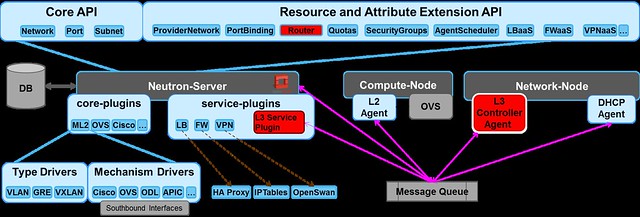
implementation, the L3 controller is embedded into  the  L3 service plugin.  

Thursday, January 15, 2015

Common Misconceptions about SDN Controller Management and Scalabilty

Here are a few common misconceptions about SDN controller management and scalability.

#1: Either Proactive mode or Reactive mode

When an SDN controller wants to enforce a set of rules or a policy on a forwarding element, it uses the southbound API, OVSDB, OpFlex, OpenFlow or others. In OpenFlow this process is called flow installation and it can be done using different methods: proactive, reactive or mixed (aka hybrid approach).  


Proactive

During bootstrap, the controller installs all flows and pipelines (multi-table entries) into all the forwarding elements.  The flows must cover all possible scenarios.
Whenever there is a change in the network, the controller removes or installs flows where necessary.


Reactive

When a packet arrives in a switch, a look-up is performed on the flow tables.
If there is no match and the switch is connected to a controller, it will forward the packet (either with or without its payload) to the controller.
In OpenFlow, this is called a PACKET_IN message.

It is also possible to create rules that forward the packet to the controller when matched and we call that...


Mixed Proactive / Reactive

With the mixed approach, you can benefit from the best of both worlds, achieving a balance between dynamic management and performance.

For frequently-used and rarely-modified flows, you install a pipeline and flows proactively.

For unmatched flows, or for flows that you want to handle in-line in your SDN application, you install a flow to forward the packet to the controller.

This mixed approach allows the controller to focus on making real-time dynamic decisions only on the traffic that requires it (reactive), while leaving the heavy-lifting of the majority of the traffic to the real-time forwarding element (proactive).

In addition, with this approach you can avoid over-provisioning the forwarding element with flows that are rare, thus dramatically reducing the number of entries in the flow tables. 

#2: Lack of Scalability and High Availability


In SDN, the control plane (i.e. the SDN Controller) is separated from the data plane (i.e. the Forwarding Elements).

Due to the centralized nature of control in SDN, we now need to support high availability and redundancy of the Control Plane.

In OpenFlow, the Forwarding Element (the Switch) connects to the controller via TCP or via TLS for secure channels.

Up until OpenFlow v1.2, whenever the connection to the controller was lost, the switch would lose the ability to forward PACKET_IN messages to the controller, thus having to drop all unmatched traffic or handle it in the NORMAL switch (only in switches that implemented the dual nature). 

This non-deterministic approach would yield unpredictable network behavior 
while the controller was unavailable.

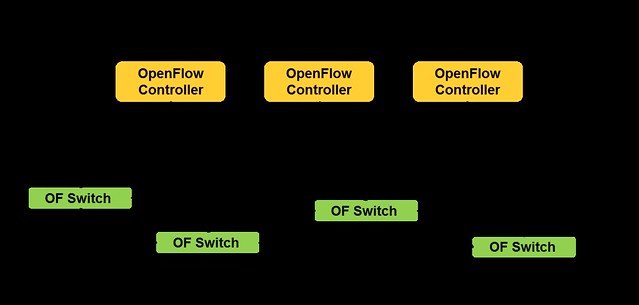
OpenFlow v1.2 introduced the capability of working with multiple controllers.
The Master and Slave modes provide a mechanism for Active-Passive high availability, whereas the Equal mode provides an Active-Active model.

OpenFlow multiple controllers


With the multi-controller capability, we gained the control plane high availability we needed, improved reliability, fast recovery from failure and controller load balancing.

#3: You cannot design SDN Applications for Really Big Scale


Utilizing the two mechanisms I covered - Mixed-Mode and Multi-Controller - is the key to designing really big scale SDN applications.

If you take care to design your application to be stateless (whenever possible) and share nothing (or little) with other controller instances you can benefit from the Reactive mode where any instance can handle any flow.

In my opinion, the best approach for achieving minimal controller response latency and maximal bandwidth while keeping the dynamic allocation of flows, is by using all of these mechanisms together.

When you add to that the OVS OpenFlow extensions and the dual-nature Hybrid OpenFlow capability (which I covered in my previous post), you can really gain a dramatic performance and management boost.


In my next post I will demonstrate how we utilized these design guidelines and capabilities in a prototype for an alternative to Neutron's L3 Distributed Virtual Router.