Showing posts with label Distributed Control Path. Show all posts

Saturday, September 26, 2015

Dragonflow Distributed DHCP for OpenStack Neutron done the SDN way

In the previous post we explained why we chose the distributed control path approach (local controller) for Dragonflow.

Lately, we have been getting a lot of questions about DHCP service, and how it could be made simpler with an SDN architecture.

This post will therefore focus on the Dragonflow DHCP application (recently released).  

We believe it is a good example for Distributed SDN architecture, and to how policy management and new advanced network services that run directly at the Compute Node simplify and improve the OpenStack cloud stability and manageability.

Just as a quick overview, the current reference implementation for DHCP in OpenStack Neutron is a centralized agents that manages multiple instances of the DNSMASQ Linux application, at least one per subnet configured with DHCP.

Each DNSMASQ instance runs in a dedicated Linux namespace, and you have one per a tenant's subnet (e.g. 5 tenants, each with 3 subnets = 15 DNSMASQ instances running in 15 different namespaces on the Network Node).
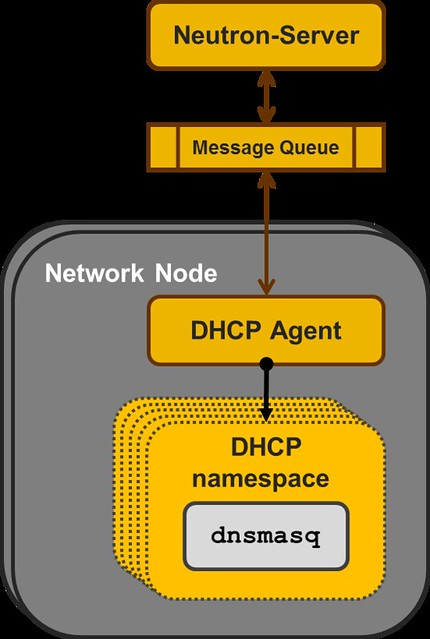

Neutron DHCP Agent 


The concept here is to use "black boxes" that each implement some specialized functionality as the the backbone of the IaaS.

And in this manner, the DHCP implementation is similar to how Neutron L3 Agent and the Virtual Router namespaces are implemented.

However, for the bigger scale deployments there are some issues here:

Management  - You need to configure, manage and maintain multiple instances of DNSMASQ.  HA is  achieved by running an additional DNSMASQ instance per subnet on a different  Node which adds another layer of complexity.  

Scalability - As a centralized solution that depends on the Nodes that run the DHCP Agents (aka Network Node), it has serious limitations in scale.  As the number of tenants/subnets grow, you add more and more running instances of DNSMASQ, all on the same Nodes. If you want to split the DNSMASQs to more Nodes, you end-up with significantly worse management complexity.   

Performance - Using both a dedicated Namespace and a dedicated DNSMASQ process instance per subnet is relatively resource heavy.  The resource overheads for each tenant subnet in the system should be much smaller. Extra network traffic, The DHCP broadcast messages are sent to all the Nodes hosting VMs on that Virtual L2 domain. 

Having said that, the reference implementation DHCP Agent is stable mature and used in production while the concept we discuss in the next paragraph is in a very early stage in the development cycle.


Dragonflow Distributed DHCP

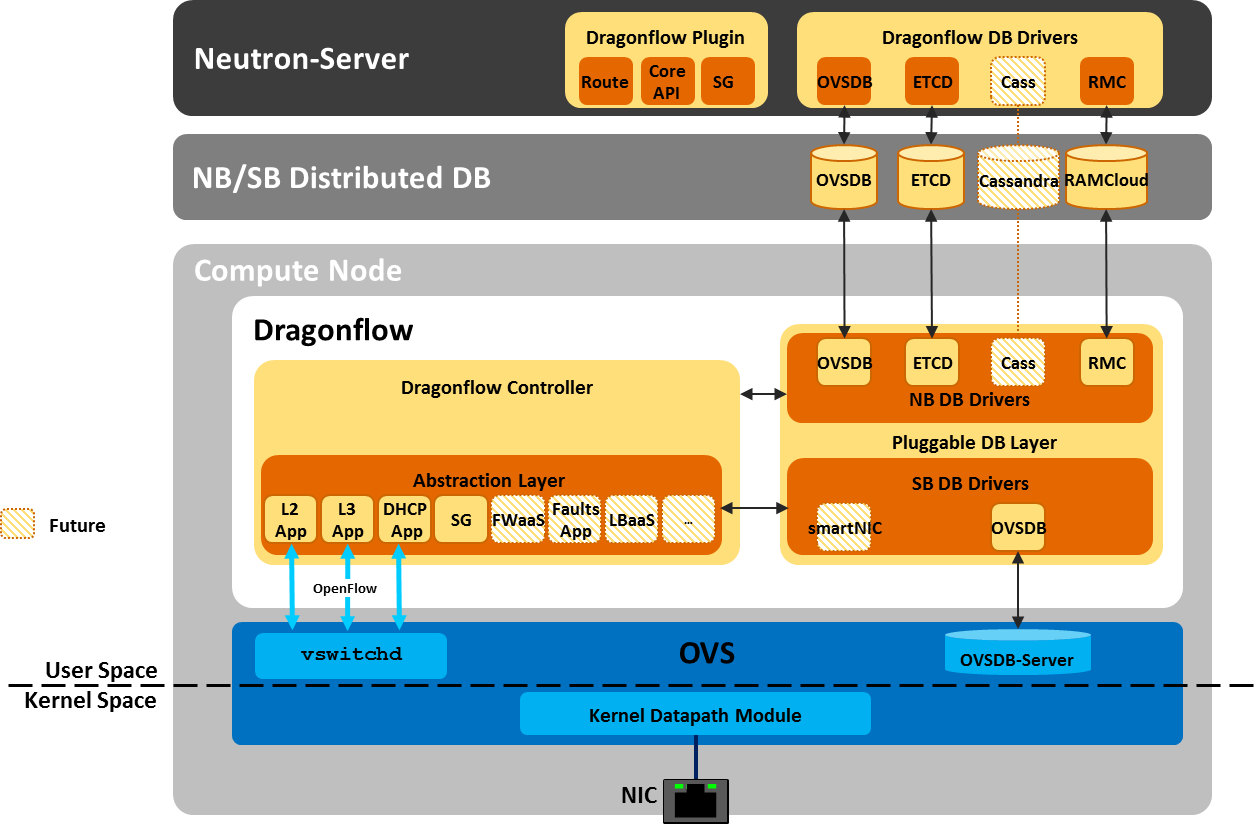
When we set up to develop the DHCP application for the Dragonflow Local Controller, we realized we had to first populate all the DHCP control data to all the relevant local controllers.

In order to do that, we added the DHCP control data to our distributed database.  

More information about our database can be found in Gal Sagie's post:
Dragonflow Pluggable Distributed DB. 

Next, we added a specialized DHCP service pipeline to Dragonflow's OpenFlow pipeline.


  1. A classification flow to match DHCP traffic and forward it to the DHCP Table was added to the Service Table
  2. In the DHCP Table we match by the in_port of each VM that is connected to a subnet with a DHCP Server enabled
  3. Traffic from VMs on subnets that don't have a DHCP Server enabled are resubmitted to the L2 Lookup Table, so that custom tenant DHCP Servers can still be used
  4. For packets that were successfully matched in the DHCP Table we add the port_id to the metadata, so that we can do a fast lookup in the Controller database, and then we forward the packet to the Controller
  5. In the Controller, we forward the PACKET_IN with the DHCP message to the DHCP SDN Application.
  6. In the DHCP Application, we handle DHCP_DISCOVER requests and generate a response with all the DHCP_OPTIONS that we send directly to the source port.
The diagram below illustrate the DHCP message flow from the VM to the local controller.
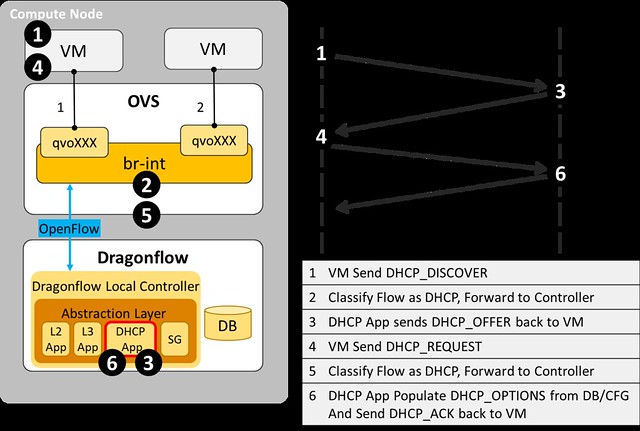
  
DHCP message flow


Benefits of Dragonflow Distributed DHCP

Simplicity - There is no additional running process(es).  The one local controller on each compute node does it all, for all subnets and all tenants
Scalability - Each local controller deals only with the local VMs
Stability - One process per compute node is easy to make sure is running at all times
Performance - DHCP traffic is handled directly at the compute node and never goes on the network

And there are surely many more benefits to this approach, feel free to post them as comments.


I want it! How do I get it?

The source code of this newly developed service in available here, and you could try it today (just follow the Dragonflow installation guide).

We are currently working on improving the stability of the L2, L3 and DHCP services of the Dragonflow local controller for OpenStack Liberty release.

The Dragonflow Community is growing and we would love to have more people joining to contribute to its success.

For any questions, feel free to contact us on IRC #openstack-dragonflow 

Tuesday, August 4, 2015

Centralized vs. Distributed SDN Control Path Paradigm

In a previous post I covered some misconceptions about SDN management and my view of the importance of the hybrid(proactive/reactive) model for scalability, and how we used this approach in the design of Dragonflow.

Today, i will discuss the two existing paradigms to SDN control path, and how it affects our road map in the Dragonflow project.

The first approach is the Centralized Controller.  Here, a controller (or a cluster of them) manages all the forwarding elements in the system, and retains a global view of the entire network. 

Most SDN controllers today run this way (ODL, ONOS, as well as Kilo version of Dragonflow).

The second approach is the Distributed Control Path.  Here, a local controller runs on each compute node and manages the forwarding element directly (and locally).  Thus, the control plane becomes distributed across the network.  

However, the virtual network topology needs to be synchronized across all the local controllers, and this is accomplished by using a distributed database.

Like everything else in life, there are advantages and disadvantages to each approach.  So, let's compare: 


Centralized Control Path


Pros


  • The controller has a global view of the network, and it can easily ensure that the network is in a consistent, optimal configuration
  • Simpler, agentless solution - Nothing needs to be installed on the compute nodes 
  • Any and all southbound APIs can be supported directly from the centralized controller (easier to integrate with legacy equipment)

Cons

  • Added latency in newly established flows, becomes a bottleneck in large scale deployments
  • Dependency on the controller cluster availability and scale
  • All advanced services are handled centrally, instead of locally, perpetuating a bottleneck as the scale grows
  • Large scale is usually controlled via BGP-based Confederations and multiple SDNC clusters which add more latency and complexity

Distributed Control Path


Pros

  • You can manage policies and introduce advanced services locally on each compute node, since you already have a local footprint
  • Significantly better scalability, now that you have the control plane completely distributed
  • Significantly better latency during reactive handling of PACKET_IN
  • Highly-available by design and no single-point-of-failure
  • Easier to integrate Smart NIC capabilities on local host level

Cons

  • Synchronization of the virtual network topology can be a challenge, as the amount of compute nodes increases
  • No global view
  • Extra compute is done on the local host
  • If you have heterogeneous forwarding elements (e.g. legacy switches), you need to have a centralized controller that connects them to the distributed control plane (which can complicate the management) 


What we chose and why


We decided earlier-on to go with a hybrid reactive/proactive model (against the widely-accepted proactive-only approach), as we saw that its advantages were overwhelming.  

The winning point of the reactive mode, as we see it, is that it improves the performance of the datapath, taking the performance toll instead on the control path of newly-established flows.  The main reason for that being a dramatic reduction of the number of flows that are installed into the forwarding element.

When combined with a pipeline that is deployed proactively, we could maximize the benefits of the reactive approach, while minimizing its cost.

However, like all solutions, at a certain scale it will break.


In very large deployments (e.g. a full datacenter), a central controller cluster becomes overwhelmed with the increase in volume of new connections.

A centralized controller made sense, while we were only handling new L3 connection path establishment (Dragonflow in Kilo).

However, when we came to add reactive L2 and other advanced services (like DHCP, LB, etc.), we realized that scaling the centralized controller cluster was becoming a huge challenge. 

A different approach must now be taken, and we believe this approach is to place a local controller on each compute node.  

Now that the control path bottleneck was mitigated, the problem moves to the logical data distribution between all the local controllers.

To mitigate that, we believe we can reuse the reactive approach, by letting the local controllers synchronize only the data they actually need (in lazy mode) use key/value distributed db engines that provide low latency. 

Sure, this will probably take some performance toll on the establishment of new flows, but we believe it will dramatically reduce the amount of data synchronization required, and therefore will take us to the next scalability level.


What we are doing in Dragonflow


We are currently working on introducing reactive L2 and L3 model into the local Draongflow controller.  

We are creating a pluggable distributed database mechanism to serve the logical data across the datacenter, which will enable the user to chose the best database to meet their specific needs and scale.

As always, we would love to have more people join the Dragonflow community and contribute to its success.

For additional information about the pluggable database layer, you can check out Gal Sagie's new blog post.